


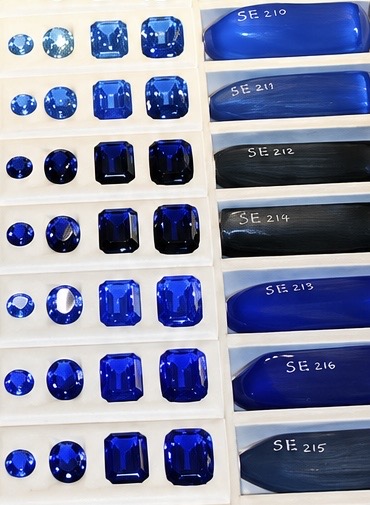
Two identical stones, a difference of several thousand francs
A 2-carat natural sapphire and its synthetic equivalent can be indistinguishable to the naked eye. The first is worth several thousand francs, the second a few dozen. This gap, invisible as it is, explains why the question comes up in almost every appraisal.
This is not a matter of mistrust towards the market. Synthetic corundum has been produced industrially for more than a century and is found, in all good faith, in a great many antique pieces passed down from generation to generation.
The Verneuil process, in brief
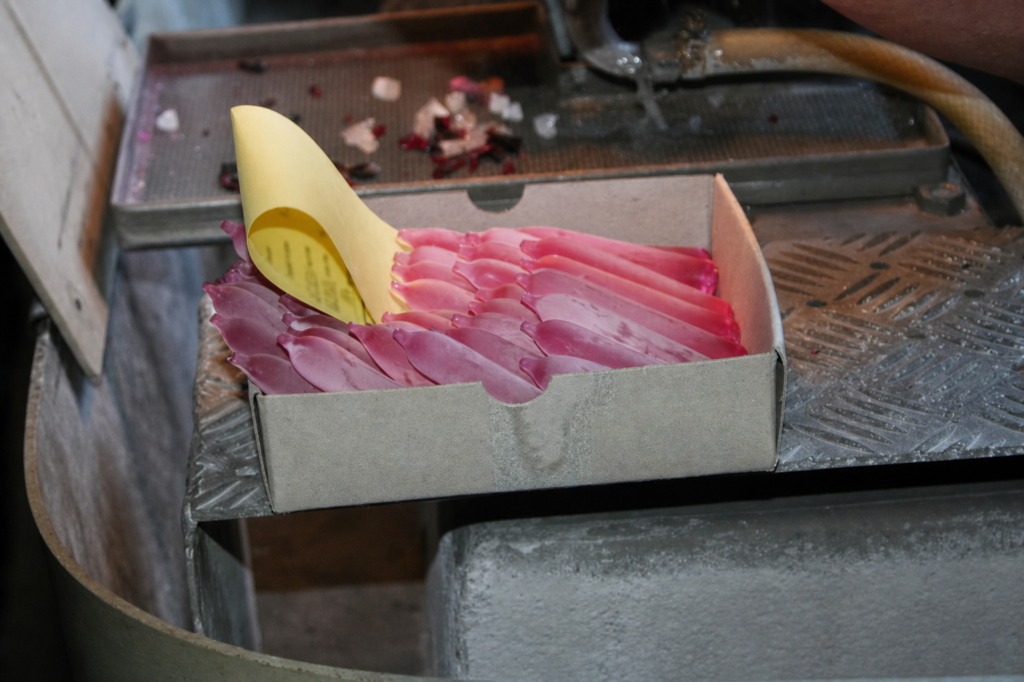
In 1902, the French chemist Auguste Verneuil published the flame-fusion process that today bears his name. The principle has remained unchanged: alumina powder, with the desired colouring oxides added, is sprinkled through an oxyhydrogen torch. The molten droplets settle and crystallise progressively on a support, forming an elongated mass known as a boule.
A few hours are enough to obtain a boule of several dozen carats. That is what makes these stones so inexpensive, and so widespread.
Synthetic corundum in fact holds a discreet but central place in the Swiss industry. Since the beginning of the twentieth century, the rubies used as bearings in mechanical movements have no longer been natural stones but synthetic corundum: a watch commonly contains between fifteen and thirty of them. The same material that, cut and faceted, is sometimes sold as a natural sapphire.
What the constants do not reveal
A synthetic sapphire is a corundum: the same chemical composition, the same crystal structure, the same physical properties as its natural counterpart. What separates them is not the material but the origin: one formed in the earth's crust over geological timescales, the other in a furnace in a matter of hours.
This identity of material has a direct practical consequence: the classic gemmological constants, those measured with the refractometer and the hydrostatic balance, do not allow a decision to be made.
| Natural sapphire | Verneuil sapphire | |
|---|---|---|
| Refractive index | 1,762 – 1,770 | 1,762 – 1,770 |
| Birefringence | 0,008 | 0,008 |
| Density | 4,00 | 4,00 |
| Hardness (Mohs) | 9 | 9 |
None of these values separates the two stones. It is the observation of inclusions that, in the vast majority of cases, reveals the identity of the gem.
Curved growth lines, the signature of the Verneuil
This is the decisive criterion, and it stems from the very geometry of the process.
A natural crystal grows according to its crystal system — for corundum, the rhombohedral system. Its growth zones therefore follow the faces of the crystal: they are straight, angular, often at 120°.
The Verneuil boule, by contrast, solidifies on a rounded front. Its growth zones follow that curvature and form curved growth lines, regular and parallel to one another — a structure that does not exist in nature.
How to observe them: in diffused light, with a 10× loupe or better under the microscope, turning the stone in every direction. The striae appear only from certain angles, which is why they can easily be missed when the examination is rushed.
Gas bubbles
The second classic clue. Flame fusion traps gas bubbles in the material: spherical bubbles, tadpole- or drop-shaped, isolated or grouped in clouds and trails.
A perfectly spherical bubble in a corundum is a strong signal. Nature does produce cavities, but they are almost always filled — with liquid, with another mineral — and take angular or irregular shapes.
One caveat, however: bubbles alone do not identify a Verneuil. Glass contains them too, often in abundance. What makes the difference is the material surrounding them — hence the value of first measuring the constants, then observing.
What a natural sapphire shows
The reverse is just as telling. A natural sapphire tells its geological history.
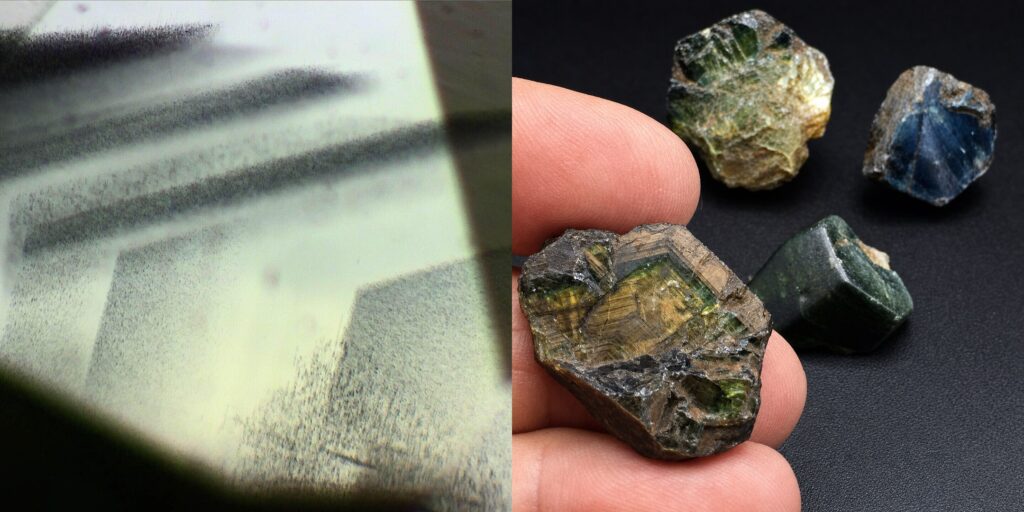
Silk, first of all — fine rutile needles, often oriented in three directions at 60° to one another. A Verneuil contains none.
Then come the included crystals: zircon, spinel, apatite, mica. Zircon is frequently accompanied by a characteristic tension halo. Then the feathers — healed fractures forming networks that resemble fingerprints. And finally an angular colour zoning, in straight bands, sometimes hexagonal, the opposite of the Verneuil's curved bands.
The presence of just one of these inclusions points strongly to a natural origin.
Synthetic is not imitation
Two words are commonly confused, sellers included: a fake sapphire may be a synthetic or an imitation, and the two have nothing in common.
A synthetic is a corundum. Its composition, its structure and its properties are those of a natural sapphire. Such is the case of the Verneuil described here. An imitation is not a corundum at all: coloured glass, cubic zirconia, synthetic spinel, assembled doublet — the material is different, and that difference can be measured.
The consequence is practical. An imitation is detected within seconds on the refractometer: index, density and hardness depart immediately from those of corundum. A synthetic, by contrast, passes all these checks without difficulty — which is precisely what makes its identification more delicate, and what justifies microscopic examination.
In other words: the cruder the counterfeit, the easier it is to expose.
Synthetic sapphire: flux and Czochralski
The Verneuil is by far the simplest synthetic to identify. Other processes exist and pose real difficulties.
Flux growth — Gilson, Chatham, Seiko — produces flux inclusions that imitate natural feathers disconcertingly well. The hydrothermal method, common for emerald, remains rare for corundum, but it can generate growth features close to those observed in nature. Czochralski pulling yields stones particularly poor in inclusions, and therefore difficult to characterise.
With these synthetics, observation alone reaches its limits. This is where advanced instrumentation takes over: infrared spectrometry, UV-visible spectrometry, elemental chemical analysis, photoluminescence. These techniques remove all doubt in every case, including where the microscope remains silent. They do, however, require equipment that few facilities possess, and dispatch to a specialised laboratory.
In everyday practice the division is simple: the microscope settles the vast majority of cases, and heavy instrumentation handles those it cannot.
Nomenclature of synthetic corundum
On one point there is no ambiguity: a synthetic sapphire must be designated as such. The CIBJO rules, followed by the trade in Switzerland, require that the term "synthetic", "created", "laboratory-created" or "laboratory-grown" systematically accompany the name of the stone.
The word "sapphire" used on its own designates a natural stone, and nothing else. Misleading appellations such as "scientific sapphire" or "reconstituted sapphire" are likewise prohibited.
Crédits photographiques : Agata Cristol, Laboratoire de gemmologie de Marseille.